


With the Malfoid memes being so out of control and viral, I’ve decided to try my hand at a little cozy fantasy slice-of-life tsundere magic academy. That’s quite a mouthful, but overnight I came up wth a pretty good story, and I’m going to try putting it up here and on Subscribe Star for paid subscribers to see how it goes.
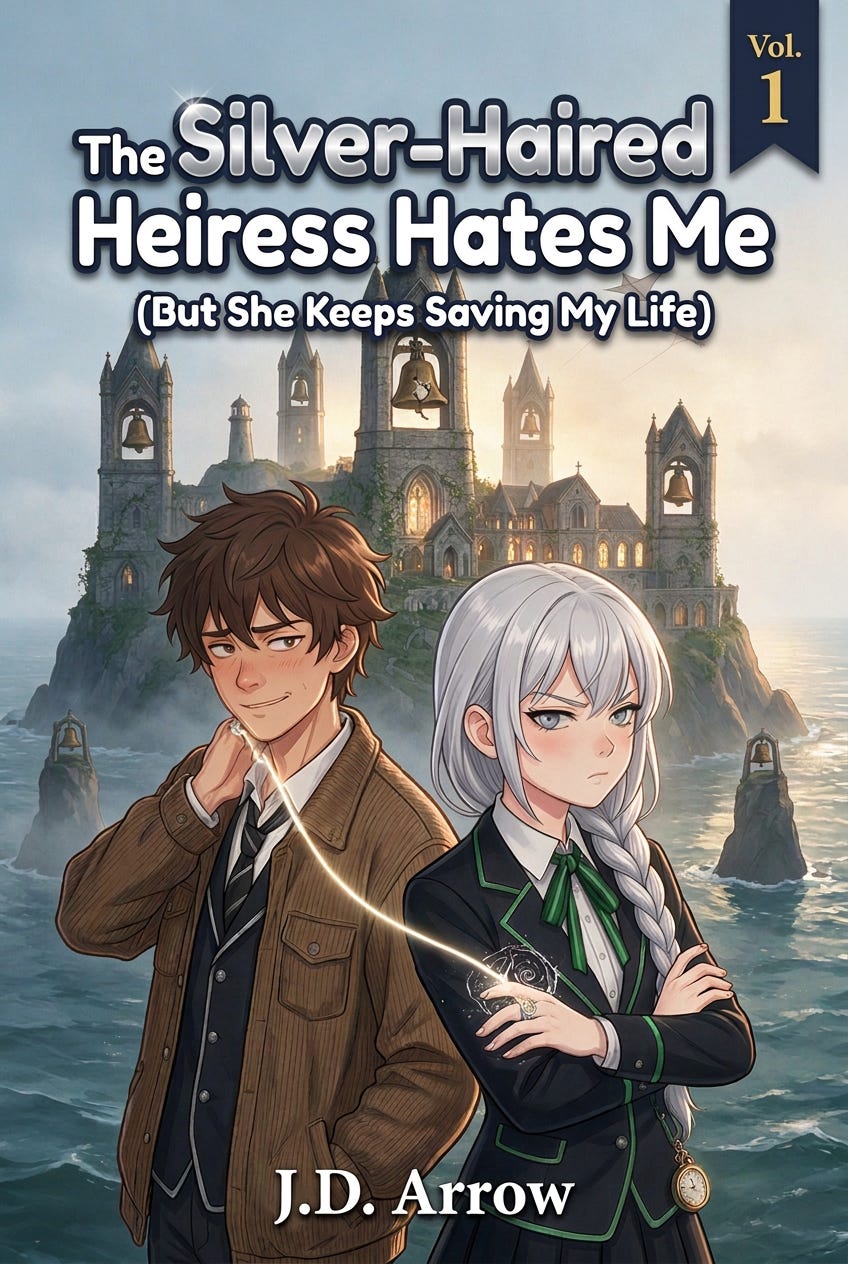
If you like Harry Potter or Japanese fantasy light novels, this is for you.
So without further ado, I left a sample for you in hopes it can get some good free subscribers on board. I appreciate the support as it takes a lot of work to run Fandom Pulse here and this is quite the undertaking on top of it!
Chapter 1:
From the Register of Kept Places, St. Brendan’s Collegium
Merrow, Weston. Place held since birth. Ring setting: iron, as for his mother. Key to be sent on the day his stone ripens and not one day sooner. The Provost asks that the key not be delivered by gull, by cat, or by Mr. Corrigan, who has been told twice.
Every compass in Merrow’s Pawn & Loan pointed at me.
Twelve of them sat in the glass case by the register, brass and plastic and one Boy Scout model with a cracked face, and every needle swung my way the second I walked in from the back. I’d played it off as a trick for customers since I was eight. Most of them figured I had magnets in my sneakers. One lady from Victorville asked if I was a government experiment, and Aunt Delphine told her yes and charged her five dollars to see it again. They never pointed north like they were supposed to, not while I was around.
It was a hundred and eight degrees that Saturday, my fourteenth birthday. The swamp cooler on the roof made a noise like a dying goat. Even though it was my birthday, I still worked and didn’t mention it. It wasn’t like we were going to celebrate anyway.
Delphine sat on her stool at the end of the counter with a crossword and four pieces of nicotine gum going at once. She’d quit smoking the year I started kindergarten and had been chewing angry ever since. The aluminum bat leaned on the shelf behind her, next to the Bible and the box of rubber bands. All three got used about the same amount.
The bell over the door jangled at ten after eleven.
A trucker came in, or at least a guy dressed like one: mesh cap, Peterbilt T-shirt, a wallet chain that hung to his knee. He carried a hard-shell guitar case by the handle, out from his body, like it might bite him. Something was wrong, very wrong.
“Nice case,” I said.
“Nineteen-seventy Gibson inside.” He laid it on the counter and popped the latches. “Worth two grand, easy.”
It was a sunburst Hummingbird with a crack in the pickguard and somebody else’s fingerprints all over the frets. This was no fake. That part he hadn’t lied about.
I picked it up and he flinched, and I noticed something odd about the way he did. People flinch when you touch their stuff, but they flinch toward it. This guy leaned back, like he was glad to be rid of it.
I looked at his hands. They were big with sunburned knuckles, but he had fingertips as soft as a baby’s. Anybody who plays guitar regularly has calluses you could strike a match on. This guy had never played anything louder than a car radio.
“What do you tune it to?” I asked.
“Normal.”
“Normal what?”
“Guitar normal.” He scratched his neck. “Look, kid, is there a grownup I can talk to?”
Delphine didn’t look up from her crossword. “He’s the grownup. I’m the muscle.”
I strummed once. The tuning sounded in Drop D, a little flat. Another lie I’d caught him in. I turned it over. On the back of the headstock somebody had stuck a tiny sticker, a white dove inside a circle, the kind churches hand out at summer camp.
“Where’d you get it?” I asked.
“My uncle. He passed.”
His eyes went to the door when he said passed. They’d gone to the door on uncle, too.
I set the Gibson back in its case, gently. “I’ll give you sixty.”
His eyebrows went up. “Sixty bucks? For a Gibson?”
“Sixty for the case. The guitar I can’t take without paperwork.” I slid the ticket pad across the counter and clicked a pen. “State law. I need your driver’s license and a thumbprint, and it all goes to the sheriff’s database by Monday.”
That was true. It was also the point where honest people reach for their wallets and the other kind reach for their keys.
He backed away from the counter.
“Forget it,” he said. “This place is a joke.”
“Your guitar,” I said.
“Keep it.”
The bell jangled. A pickup with no tailgate tore out of the lot and fishtailed onto Main Street, and the dust hung in the heat a long time after.
Delphine turned a page. “Dove sticker?”
“Grace Fellowship, down in Hesperia. They did a car wash fundraiser in June. I bet they’re missing a band.”
“Call ‘em.” She snapped her gum. “And kid. There’s no reward in it.”
“I know.”
“Just so you know it.”
I decided to call anyway. Nothing at Merrow’s was free, and that cut both ways. If you didn’t pay for a thing, you didn’t keep it. Delphine had been teaching me that since before I could reach the till.
I found the church’s number on a flyer still pinned to our corkboard. A youth pastor named Ruiz picked up on the second ring and made a sound when I said Gibson, like somebody had handed him back a kidney. He said he’d drive up after lunch. He said God bless you, twice. I had no idea what to do with that. Nobody had ever blessed me over a guitar before. So I said you’re welcome, and wrote Ruiz, 1 pm on the back of my hand, and hung up.
When I set the phone down, Delphine was watching me over her reading glasses.
“Fourteen,” she said.
So she’d remembered. I shrugged. “Yep.”
“Huh.”
She went back to the crossword, but her pen didn’t move. She was looking at the compass case instead, at twelve needles all pointing at me, and her jaw worked that gum like it had done something to her.
“What?” I asked.
“Nothing. Go check the cooler pads.”
I went. Behind me, every needle in that case turned to follow, patient as a debt collector.
I didn’t know yet that I owed anybody anything.
###
Delphine’s swamp cooler sat on the roof like a tin doghouse, and every August the pads dried out faster than she could complain about them. I climbed the ladder out back with a garden hose and a new set of pads from the hardware store. The tar paper was soft enough to hold my footprints.
I unscrewed the side panel. A gecko shot out of it and down the drainpipe, and the panel’s edge of rusty sheet metal caught my palm on the way.
I yelped. It stung for about two seconds. Then it stopped.
Blood beaded along the cut. I sat back on my heels and waited, because I already knew how this went.
Cuts didn’t stay on me. When I was seven I split my chin open on the bike rack at school, and by the time Delphine got me to urgent care, the doctor couldn’t find anything to stitch. He said kids heal fast. Delphine said thank you and drove me home without a word. It was another of those little, weird things like the compass that didn’t make sense, but I’d learned not to question too much.
Watches didn’t stay on me either. There were seven dead ones in my desk drawer, every one from the case downstairs, every one stopped within a day of going on my wrist. Battery, windup, and a solar one Delphine swore was indestructible. None of them lasted.
And I had never been cold. Now, I lived in the California desert which was pretty hot during the summer, to be fair, but what most people don’t know is that Barstow nights drop into the thirties in January, and I still slept with the window open and a sheet.
I let the cut annoy me, which was a mistake. Under my sneakers, through the roof, the LOANS sign over the front door started to buzz.
The lights did that when I got mad. They’d done it since I was little. When I was nine, a kid at school called Delphine a crazy old lady. I came home so angry that every bulb in the shop burst at once. Delphine swept up the glass without asking what happened. Then she sat me on the counter and held my face in both hands.
“Nobody sees that,” she said. “You hear me?”
“What is it?”
“It’s nothing. It’s you being a pain in my neck.” Her thumbs shook. “Promise me.”
I’d promised her, and I’d kept it. When the lights started up, I did what I always did. I counted the till in my head. Once I got to dimes, the buzzing stopped.
The cut was a pink line. By the time I’d hosed down the new pads and screwed the panel back on, it was gone.
Even though I knew I was a freak, I wondered if it was hereditary, and that led me to thinking about my mother.
Her name was Elinor, and she died the night I was born, and that was the whole list of things Delphine would tell me. I found one picture of her when I was ten, digging in a dresser I wasn’t supposed to touch: a woman on the deck of a boat in heavy fog, laughing, one hand up to block the camera. She had a dark, plain ring on.
Delphine caught me holding the picture. She took it out of my hands, and I never found it again, but I remembered the ring.
Pastor Ruiz pulled into the lot at one o’clock on the dot in a minivan with a GRACE FELLOWSHIP magnet on the side. He was younger than I’d figured, thirty maybe, with a soul patch and a T-shirt that said JESUS IS MY CO-PILOT on the front and BUT HE DRIVES on the back.
“You must be Wes.”
“Yes, sir.”
He opened the case on the counter and went quiet. He touched the crack in the pickguard with one finger.
“Our kids saved for two years for this,” he said. “Somebody took it right out of the van in the Stater Bros. parking lot. I figured it was in Vegas by now.”
“The guy who brought it in didn’t play.”
“How could you tell?”
“Soft fingers.”
He laughed and pulled out his wallet. “Here. For your trouble.”
It was a twenty. I kept my hands on the counter.
“No thanks.”
“Come on. Take it.”
“I didn’t sell you anything,” I said. “If I didn’t sell you anything, I don’t get paid. That’s how it works.”
From her stool, Delphine turned a page of the crossword. “He’s like that. I raised him well.”
Ruiz looked from her to me, and then he put the twenty away and stuck out his hand instead. I shook t and his watch went dark.
He tapped it twice. “Huh. Battery, I guess.”
I put my hands in my pockets.
He left a flyer on the counter on his way out. Youth Group, Wednesday Nights, Free Pizza. “In case you’re ever down in Hesperia,” he said.
“Nothing’s free,” I said.
He grinned at me from the door. “Grace is. That’s kind of the whole pitch.”
The bell jangled, and the minivan pulled out, slower than the pickup had.
I meant to throw the flyer away. I folded it into my back pocket instead, and I didn’t think too hard about why.
When I went back to the counter, every compass in the case swung to meet me, same as always.
Across Main Street, in the shade of the bail bonds office, a man in a long grey wool coat was standing perfectly still, looking at our window. It wouldn’t have struck me as too strange, but this was August, and it was a hundred and ten degrees out.
###
By two o’clock it had climbed to a hundred and twelve, and the man in the wool coat was still standing across the street.
I’d checked on him four times. He hadn’t moved or looked at his phone or gone into the bail bonds office to get out of the sun. He just stood in that thin strip of shade with his hands in his coat pockets and looked at our window, and every time I looked back, he was looking at me.
Delphine had gone into the storeroom to fight with the inventory binder, so I was alone at the counter when he finally crossed Main Street.
He didn’t hurry. A truck honked at him, and he didn’t even turn his head.
The bell jangled. A breath of cold air came in with him. I started to suspect there might be something beyond normal-strange about him.
Up close he was grey all over. From his coat, to his flat-combed hair, even his eyes, and his skin. It didn’t look healthy. There wasn’t a drop of sweat on him anywhere, and I could tell, because I was looking for it.
“Afternoon,” he said. His voice was soft and polite. It had a radio quality to it, a sound that could lull a person.
“Hi. Can I help you find something?”
“I believe you can.” He stepped up to the counter and looked down at the glass case. “Those compasses. I’m told they do a trick.”
“It’s just magnets,” I said. “In my shoes.”
“May I see?”
The thing about working a counter is you don’t get to pick your customers. Delphine’s rule was that anybody polite got polite back, until they gave you a reason. He hadn’t given me a reason yet, except for the coat, and the cold, and the fact that he’d stood in a hundred and twelve degrees for two hours to watch me.
So I stepped closer to the case.
What usually happened was the needles would swing toward me, the customer laughed, and I sold them a compass for eight dollars. This time the needles swung toward me, and then they swung back toward him.
They did it twice. All twelve of them twitched between us like they couldn’t decide. Then they settled back on me and stayed there.
The man smiled for the first time in a manner I didn’t like one bit.
“There,” he said. “There you are.”
“What does that mean?”
“You’re Elinor’s boy.”
I blinked, taken aback.
“How do you know her name?” I asked.
“Oh, a lot of people knew your mother. She was very well known where I come from.” He tilted his head and studied me, the way I’d studied the trucker’s hands that morning. “You have her chin. Did you know that? And her temper, I’d guess. Does the light flicker when you’re angry, Weston?”
He knew my real name. Nobody called me Weston except the school district.
Above us, the fluorescent tubes in the ceiling started to buzz.
I started counting the till in my head, fast. Twenties, tens, fives.
“Ah,” the man said, pleased, and looked up at the lights.
The storeroom door banged open.
Delphine came out of the back with the aluminum bat already in both hands. I’d seen her pull that bat on a meth head and on a guy who tried to pawn a stolen wedding ring, and both times she’d been loud about it. This time she didn’t say a word until she was standing between me and the counter.
“Out,” she said.
“Mrs. Merrow.” The man inclined his head to her, very polite. “You’ve kept him well. I’ll say that for you.”
“It’s Miss. And I said out.”
“Fourteen years is a long time to keep a promise.”
“Then I’m good at it. Get out of my store, or I’ll find out what color you bleed.”
He looked at the bat, and then at her face, and then at me. He didn’t look scared.
“Happy birthday, Weston,” he said, and he left.
The bell jangled behind him. He crossed Main Street at the same slow pace and walked off toward the train yard, and the heat shimmer swallowed him up before he reached the corner.
Delphine didn’t lower the bat until he was gone.
“Who was that?” I asked.
“Nobody.”
“He knew Mom’s name. He knew my name. This isn’t normal.”
“I said he’s nobody, so leave it at that.” She walked to the front door, flipped the sign to CLOSED, and turned the deadbolt. It was ten after two on a Saturday. She always kept the store open, even on holidays. Nothing could deter Delphine from the potential of making a buck. This was getting stranger by the second.
“Go upstairs and leave me be for an hour,” she said.
“I have questions, though.”
“You’re not getting answers. Do as I say.”
She leaned the bat against the door frame instead of putting it back on the shelf.
On the floor just inside the door, where the man had stood, there was a footprint. It was wet, which again didn’t make sense given the high heat of summer in the desert. I crouched down and touched it. It was cold.
“Off with you!” Her tone was much angrier.
I frowned at the footprint and trudged upstairs.
###
I’d spent the afternoon in my room pretending to read and listening to Delphine act strangely downstairs. She didn’t open the shop back up. Mostly she paced. Once she got on the phone in the storeroom and talked low enough that I couldn’t make out a word.
When she finally came up, she was carrying a Del Taco bag and a little white box from the Chevron on Main Street.
“Birthday dinner,” she said, and set it all on the kitchen table.
Inside the box was a chocolate cupcake with a plastic lid, the kind that sits by the register next to the beef jerky. She dug a birthday candle out of the junk drawer, stuck it in the frosting and lit it with a kitchen match.
“Make a wish,” she said. “Don’t tell me what it is.”
I wished I knew who the man in the grey coat was. Then I blew out the candle.
We ate at the table with the TV on mute. Delphine didn’t touch her burrito. She kept looking at the window, even though there was nothing out there but the parking lot and the sign for the bail bonds place.
“Who was he?” I asked.
“Eat your taco.”
“I”m not going to give up on this. He knew mom’s name.”
“Lots of people know lots of names.” She picked at the foil on her burrito. “Doesn’t make them anybody worth talking to.”
“He said she was famous where he comes from.”
“He says a lot of things, apparently.” Then she stopped picking at the foil, age lines showing on her face. “Your mother liked chocolate. Those cupcakes, especially. She used to eat the frosting off first and leave the rest for me.”
It was the most she’d told me about my mother in three years. I sat very still in case she’d say more.
She didn’t. Instead, she got up, threw her burrito away without eating it, and went to bed at eight o’clock.
I picked at the rest of my food before trying to go get some sleep myself. I found my mind racing, and that i couldln’t.
Around midnight, I went down the back stairs to the shop in my socks. I revert to counting tills when I’m uncomfortable, whether I’m angry in my head, or physically doing so when I can’t sleep. It’s not that I think Delphine got it wrong. It’s that money is the one thing in the building that always comes out the way it’s supposed to, and I like that. I counted it twice. It came out the same both times, eight hundred and forty dollars and fifteen cents.
Before I went back up, I stopped in the living room and looked at the music box.
It sat on the top shelf above the TV, where it had been my whole life. It was small, about the size of a loaf of bread, made of dark wood with brass corners, and it had a keyhole in the front and no key. Delphine said it was my mother’s, and that the key was lost, and that if I ever pried it open with a screwdriver, she’d sell my bike. There was a design carved into the lid, a looping shape like a letter from an alphabet nobody uses.
On the way back to my room, I put my hand on the door to push it open, not remembering having closed it in the first place. This day kept getting odder, but I hoped tomorrow would go back to some semblance of sanity. Inside, my old canvas work jacket hung on the hook, which I hadn’t left there either. I didn’t wear my jacket during the summer.
I put my hand on it. The left pocket was warm, like something in there had been sitting in the sun.
I reached in and pulled out a key.
It was brass, about as long as my finger, with an old-fashioned round bow and a single tooth. It wasn’t from the shop. I found myself glancing around the room, but it was quiet, and no one was there.
I went back down to the counter, turned on the little lamp, and got out Delphine’s jeweler’s loupe from the drawer. There was no maker’s mark anywhere on it. But on the round part of the bow, so small I’d have missed it without the loupe, somebody had carved a design.
It was the same looping shape as the one on the music box lid.
My heart beat hard enough that I could hear it. I went back upstairs, pulled a chair over to the shelf, took down the music box and tried the key.
It didn’t fit. The key was twice as big as the keyhole.
I sat down on the floor with the music box in my lap and the key in my hand and tried to figure out what kind of person sneaks into your room and leaves you a key that doesn’t open anything. It had to be the man in the grey coat. There were too many coincidences otherwise. But how did he get inside?
I put the music box back exactly where it had been. Then I went to the top of the back stairs and looked down into the dark shop.
The compass case was right there at the bottom of the stairs. Most of those compasses had glow-in-the-dark needles, and in the dark they showed up as twelve little green lines.
They were all pointing up the stairs. They moved with the key. I tested it a few times. Shaking my head in confusion, I took the key into bed with me and closed my fist around it, guarding it with my life. It had to mean something.
Continue to Chapter 2:
Fantasy Fiction: The Silver-Haired Heiress Hates Me (But She Keeps Saving My Life) Chapter 2

This has proven to be quite the hit so far. Thank you to all the new subscribers for coming in and reading and subscribing; it means a lot and helps keep me going both on the author side and to sustain our news business here. I hope you’re enjoying this!
The story is good so far I just wish I could get a audio book copy so I can listen to it in my car as I go to work I enjoy audiobooks I have some of your other books on audio Haven't finished the collection yet Working on buying them all
(takes a slow deep breath and counts coins until the lights stop buzzing.)
That was excellent. If that had been the introduction to Harry's first book, it would have made for better reading.
Having the compasses orient on his is better than an owl with a letter any day.